Start here: which Apple IAP identifier disagrees?
If transactionId, originalTransactionId, and subscription status disagree, compare the exact endpoint, environment, filters, pagination, and observation time before changing a payment record. A different API view is not independent proof of a second charge.
Use the endpoint comparison to choose the right query, then follow the reconciliation checklist. For the original Chinese case and screenshots, see Apple IAP subscription investigation in Chinese.
Keep identifiers and business concepts separate
Apple subscription troubleshooting becomes difficult when a transaction, a subscription relationship, and an application account are treated as the same thing. Use the exact field names from the API you consume: modern App Store Server API payloads use transactionId and originalTransactionId, while older receipts use names such as original_transaction_id.
transactionId identifies a transaction. originalTransactionId relates it to the original transaction in its subscription history. Neither identifier is your application’s user ID. Keep verified ownership and account binding as explicit application records.
This article revisits a case reported in March and April 2025. The case describes observed inconsistencies; it does not establish that every current Apple response behaves the same way. Documentation was reviewed on October 16, 2026, without replaying the historical transactions against production APIs.
The historical symptom: apparently duplicate transactions
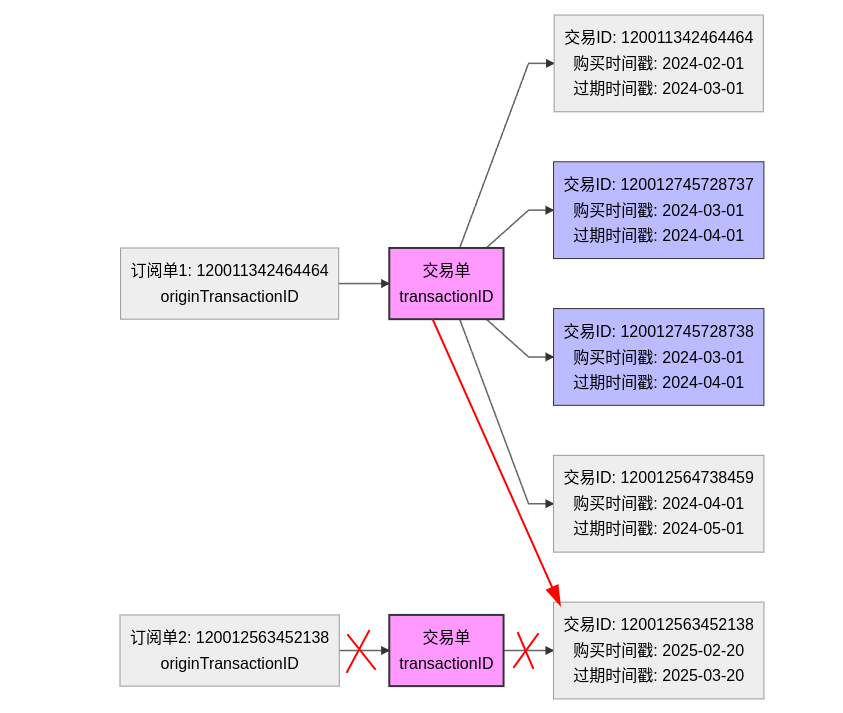
The earlier investigation recorded two different transaction IDs with matching purchase and expiration times. Looking up either ID individually returned information, while other views exposed only one of them. The examples in the original report used IDs ending in 737 and 738.
Matching dates do not independently prove that two records represent one charge. Similar numeric IDs also provide no safe rule for finding a related transaction. Do not probe adjacent IDs or merge payment records based on timestamps alone.
Keep each source response, its observation time, environment, request parameters, and verification result. Compare product, subscription group, transaction relationship, and relevant signed fields before deciding what the discrepancy means.
Ask each API the question it answers
| Source | Useful question | Important limit |
|---|---|---|
| Transaction History | What transactions are returned for this customer and query? | Follow pagination and record filters |
| Transaction Info | What does Apple return for this particular transaction ID? | A single record is not complete history |
| All Subscription Statuses | What subscription status is reported for this customer in the app? | Status is not a list of every charge |
| Order ID lookup | What signed transactions correspond to an App Store order ID? | An order ID is a different identifier |
| Server Notifications V2 | What event did Apple send? | One delivery is not a complete state snapshot |
Get Transaction History
The current v2 endpoint is /inApps/v2/history/{transactionId}. Preserve the query options and follow the response’s pagination using its revision token while it reports more results. A partial page or a filtered query can look like missing history.
In the historical case, the two disputed input IDs returned the same visible history. That observation alone did not explain why their individual lookups differed. See Get Transaction History.
Get Transaction Info
/inApps/v1/transactions/{transactionId} retrieves information for a particular transaction. In the reported case, each of the two IDs could be queried individually. Retain both results as evidence rather than overwriting one because a different endpoint returned fewer records. See Get Transaction Info.
Get All Subscription Statuses
/inApps/v1/subscriptions/{transactionId} provides subscription status information. Its purpose differs from a historical transaction listing. Inspect the signed transaction and renewal information associated with each returned group and status. See Get All Subscription Statuses.
Look Up Order ID
/inApps/v1/lookup/{orderId} accepts an App Store order ID. It does not accept an arbitrary internal order number in its place. This route was not tested in the original investigation, so there is no historical outcome to infer from it. See Look Up Order ID.
App Store Server Notifications V2
Verify the signed notification and its nested signed data before using it. Keep delivery deduplication separate from transaction processing: receiving the same event twice must not grant benefits twice, and receiving a new event does not necessarily mean a new payment occurred.
Apple’s App Store Server Library provides API and signed-data verification support. Base64-decoding a JWS payload is inspection, not signature verification.
Reconcile instead of choosing a favorite source
Compare the sources with their scope and observation times intact. Persist raw evidence securely, normalize the fields you use, and rescan history or status as appropriate. Keep an unresolved discrepancy explicit rather than converting it into a second charge, refund, or entitlement change.
When an original transaction relationship changes
The original case also described a later purchase appearing under a different original transaction relationship after a long inactive period. The public forum report records the association problem and discussion; it is evidence of a reported case, not a universal account-mapping contract.
Do not infer that one subscription group must map to one immutable original ID for all time, or that a changed original ID means a new application user. Apple documents previousOriginalTransactionId as the original identifier before a subscription migration. Inspect it when present in that documented context; its existence does not explain every historical association discrepancy. Do not fabricate a previous relationship when the field is absent.
Preserve distinct records during investigation
Keep the received transaction identity, the current original relationship, and any previous relationship as separate fields. Use your verified account-binding evidence to establish ownership. A relationship update should not silently erase the original evidence or merge two users.
The reported return to an earlier relationship
The earlier article included this screenshot when describing responses that again pointed to an older original transaction relationship after March 17, 2025:
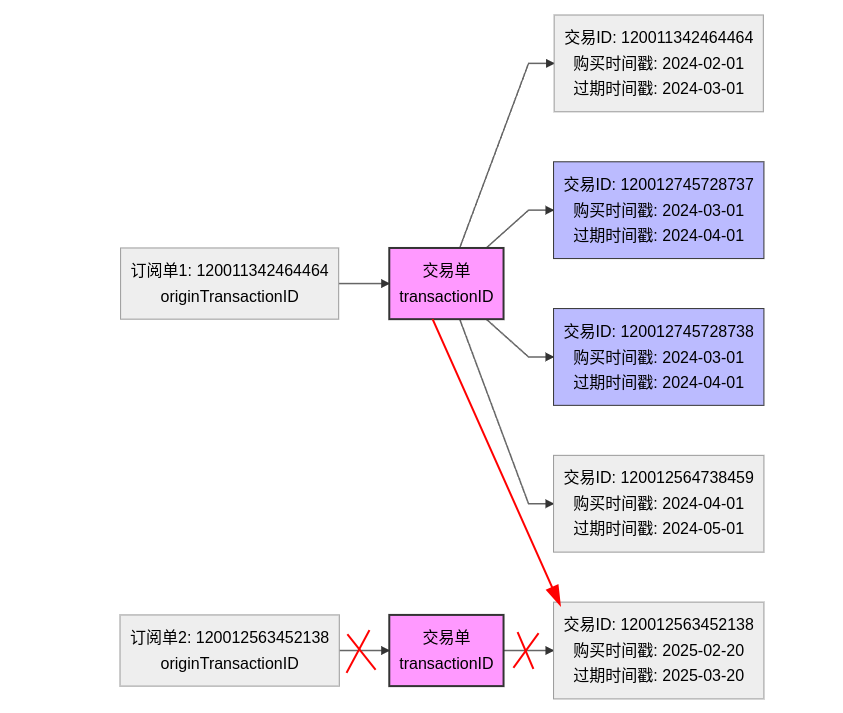
This is a historical observation from the case. It should not become a hard-coded date rule in a payment system.
Review API evolution without guessing release dates
Payloads and notification handling evolve. Review Apple’s documentation and the server library when maintaining a subscription integration. Keep unknown fields forward-compatible, validate fields your business decisions depend on, and preserve the environment and bundle identity used during verification.
The earlier version’s loosely sourced release timeline has been removed. A documented field’s current existence does not, by itself, prove the date on which a historical production behavior changed.
Make a support report reproducible
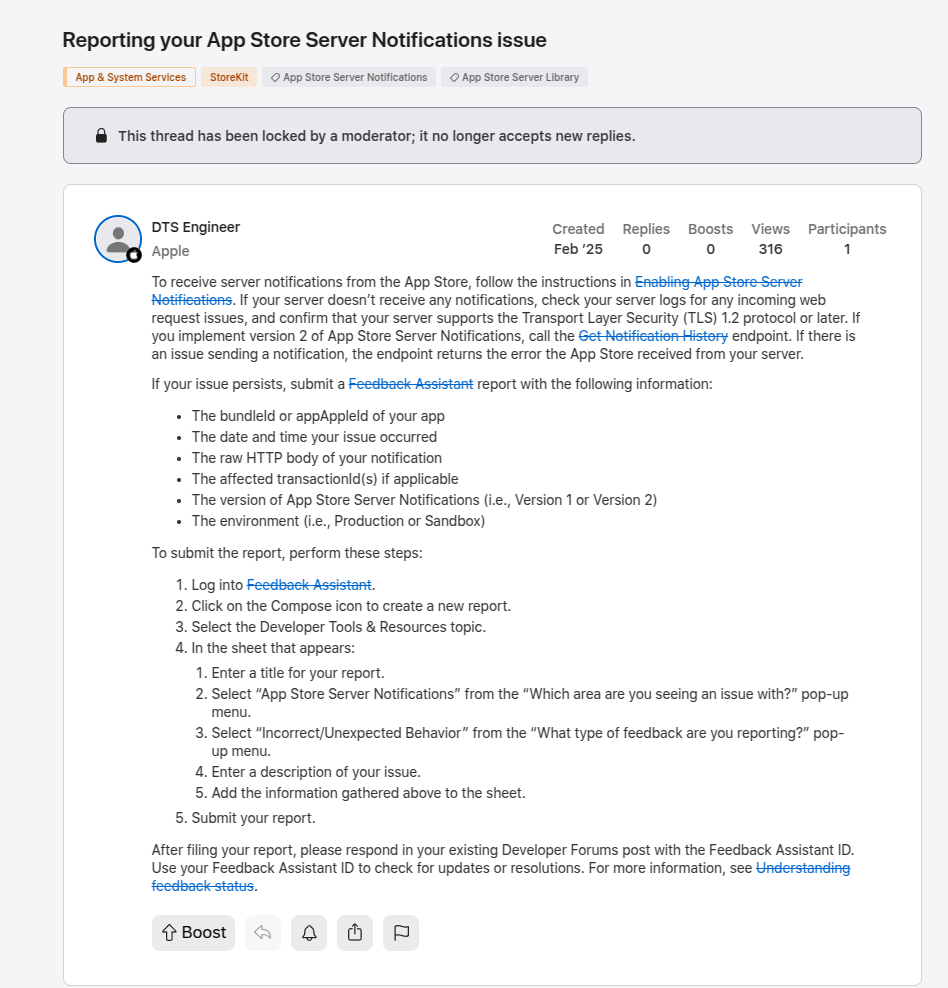
The March 2025 forum thread includes an Apple DTS response asking for a Feedback Assistant report. Prepare the exact endpoint, UTC observation time, environment, relevant identifiers, request filters, pagination state, and verified response differences. Share identifiers and signed payloads only through an appropriate support channel.
Keep the feedback and evidence together
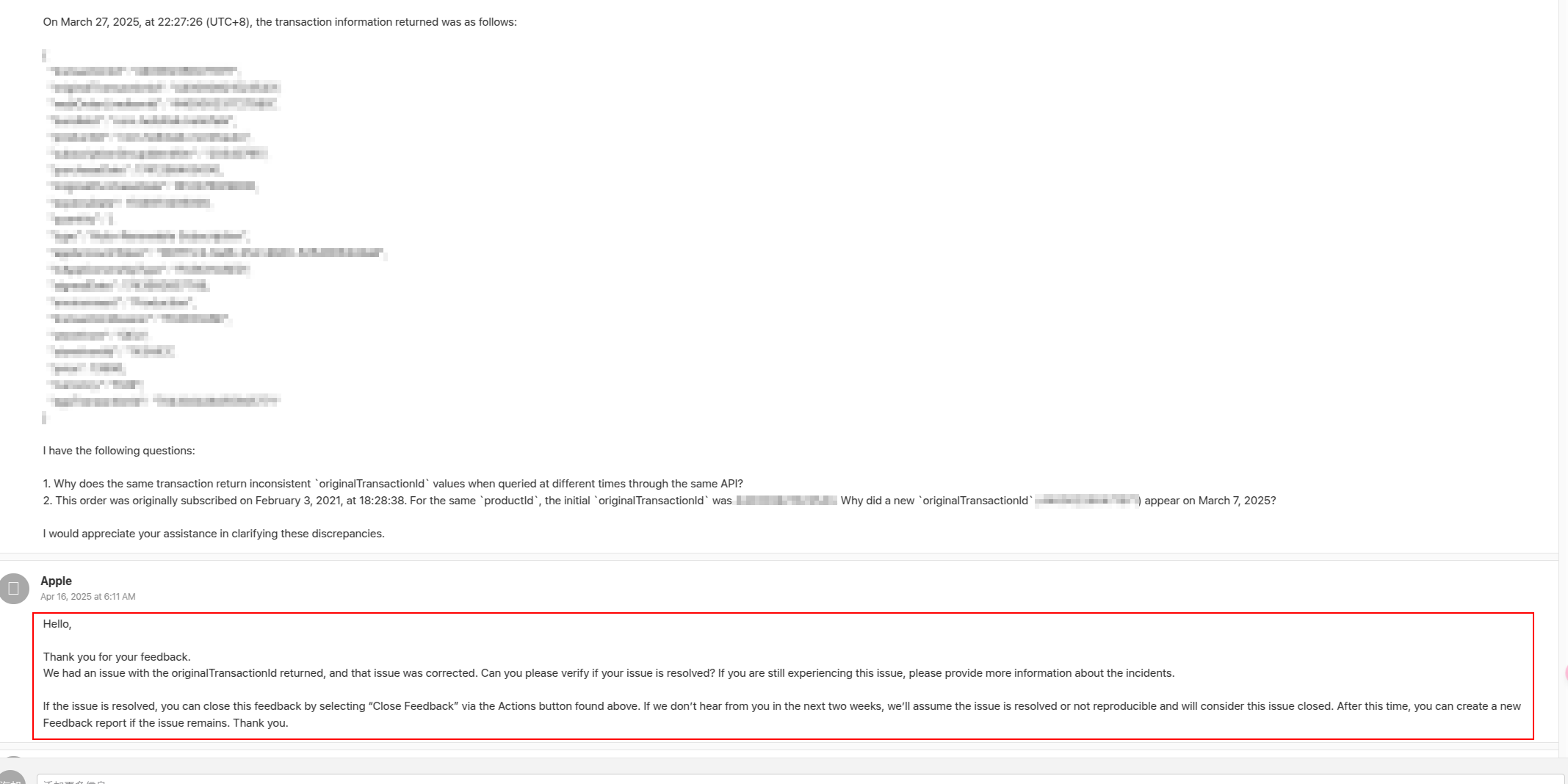
Record the Feedback number alongside the original evidence and any later comparison. A brief support reply is not enough to establish the cause or prove that every affected transaction has been repaired.
A reconciliation checklist
- Confirm the app, environment, and verified account binding.
- Verify signed data and retain source responses with observation times.
- Retrieve complete history where needed and inspect current status separately.
- Distinguish notification delivery, financial transaction identity, and entitlement state.
- Preserve conflicting relationship evidence and escalate a reproducible case before performing destructive repairs.
The useful outcome is an explainable ledger and entitlement decision. A successful HTTP response, a decoded payload, or two matching timestamps is only part of that evidence.